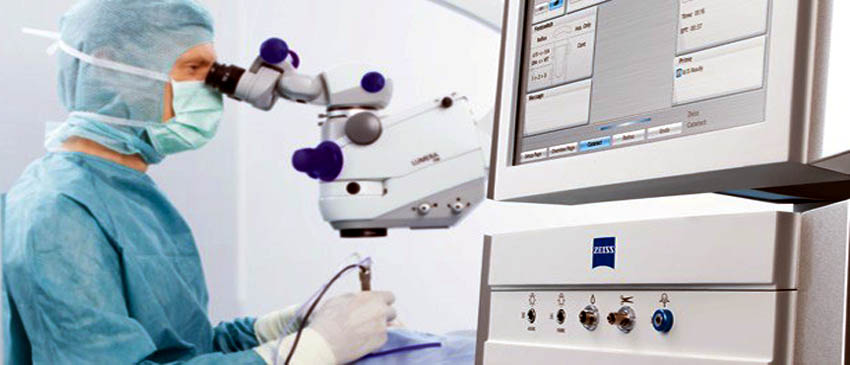
Cataract is an age related opacification of the clear human lens.
It can be easily treated by replacing the opacified lens with an intraocular lens (IOL).
If you are from a far off place and cannot reach the hospital by 9.00 AM then preferably you can get admitted the previous night, in case you want to come directly in the morning remember to use the drops as suggested by your doctor before you reach the hospital. Once your surgery is done you can relax for a couple of hours in our recovery room and then leave.
No. Usually the procedure is done under local anesthesia after giving a small injection prick below your lid and you are conscious throughout the procedure. PHACO can however be done under Topical anesthesia if the patient is co-operative. This avoids the injection prick.
The technique of removal of the opacified lens can be through a Small incision cataract surgery SICS (5-6mm) or PHACOEMULSIFICATION surgery (2-3mm).
The lesser the size of incision the better the wound healing and earlier the recovery. Lesser chances of complication and postoperative astigmatism.
Generally If your cataract is soft and not fully mature you can opt for the newer PHACO Technique and for mature and hard cataracts SICS is still the preferred technique. However your Surgeon will decide on this after a comprehensive evaluation of the eye.
IOLs can be hard or soft: Soft ones are newer and better tolerated and have less chances of developing PCO. Rigid or Foldable: Rigid lenses need larger incision for implantation where as foldable would need lesser incision sizes. Monofocal or Multifocal: Monofocal IOLs correct vision only for distance and you will need to use glasses for near work. Multifocal IOLs on the other hand can provide glasses free vision for distance, intermediate and near work.
Complications rate in cataract surgery is very less and the possible complication are PCO, PCR, Infection etc in which most of them are easily managed by an experienced surgeon.
While your surgeon performs the cataract surgery and removes the opacified lens, he retains a delicate capsule behind the lens to provide support for the IOL being implanted. In some patients this capsule may opacify over a period of time after the surgery. This is called PCO - Posterior capsular opacification.
The opacification in the posterior capsule can easily be managed with a laser therapy clearing of the opacified area in the path of vision.
It is advisable to wear protective glasses to avoid any dust or contamination on to the operated eye till the wound heals. It is better not take a hairwash till 2 weeks after surgery. Use all the medications prescribed by the doctor for 4 weeks.
Visit 1: Next day of surgery or Evening after your surgery. Visit 2: 1 week after your surgery, drops frequency would be reduced from this visit. Visit 3: 5 weeks after your surgery, all medications would be stopped after this visit.
In majority of the cases you may not need glasses for distant vision and may need use glasses for near work, this can also be avoided if you opt for a multifocal IOL.
Excessive pain and redness, lid swelling and decreased vision should alert you immediately and you should take an emergency consultation with your doctor.
2 weeks in case of SICS surgery provided your work is not physically strenuous, any active physical work will have to wait till 5 weeks. 3 to 5 days of rest is sufficient in case of PHACO surgery.
Yes, you can do all these in moderation for a limited time period (1-3hrs not at a stretch) for at least 1 month after your surgery and then get back your routine.
No, you can have your regular diet as normal unless advised specifically for any other systemic condition.
Have More Questions About Cataract Surgery?
Book an appointment with our experienced ophthalmologists at Vijaya Bhaskara Reddy Eye Hospital
Call: +91 8985657102 Book Appointment